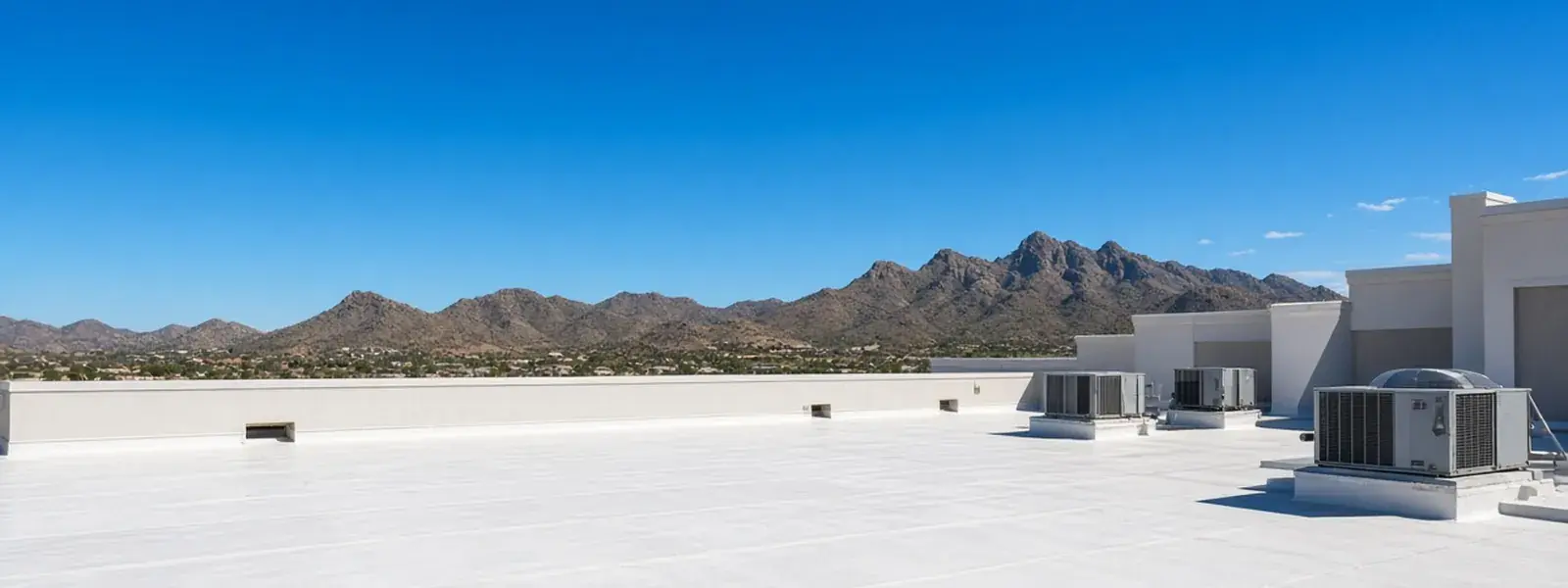
A commercial flat roof in Scottsdale is a drainage machine sitting under Sonoran sun. Surface temps run 160F to 175F in June. Then a monsoon cell can drop a half inch in fifteen minutes. If the slope is lazy, if a scupper is undersized, or if the last recover left a birdbath against the parapet, that water sits and cooks the membrane. Property managers usually call after a tenant reports a stain, after an infrared scan lights up wet polyiso, or when a buyer’s inspector flags ponding. Scottsdale Commercial Roofers designs and installs low-slope roofing for East Valley buildings. We match the membrane to the deck, rebuild the drains, and put taper where water actually stalls. That is the difference between a roof that sheds a July cell and one that calls you back in August.
What this job includes
- Tapered polyiso layout with documented LTTR, not a flat recover over existing birdbaths
- Cover board (gypsum or high-density iso) under the membrane at the field and perimeters
- Clamp-ring drain rebuilds with new lead or coated-metal flashing bowls
- Scupper and conductor-head sizing checked against monsoon burst rates
- Crickets behind HVAC curbs, pitch pockets, and wide parapets
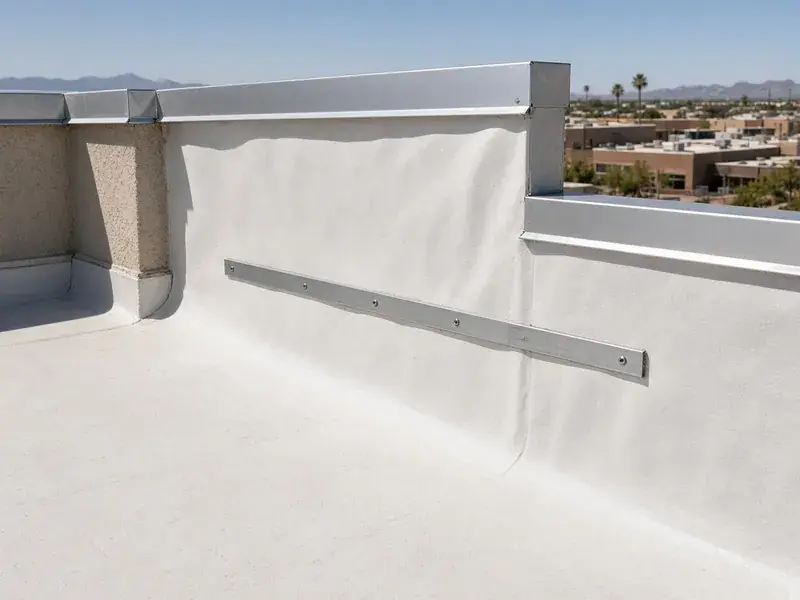
- Termination bar, counterflashing, and parapet wrap details that survive thermal cycling
- Walk pads at RTU service paths and roof-hatch landings
- Night-seal protocol so an open tear-off is not left raw before a storm cell
- Core cuts and moisture mapping before we commit to recover versus tear-off
- As-built photos of welds, fasteners, and drain bowls for your file
When this is the right call
Water sits 48 hours after a monsoon
IBC and NRCA both treat standing water past 48 hours as a design problem, not a weather problem. In Scottsdale that ponding bakes the membrane and drives moisture into the cover board. If you can still see a sheen two days later, the taper or the drains are wrong.
The roof already has two membranes
Most jurisdictions, including City of Scottsdale plan review, will not let you stack a third roof. If cores show two complete systems, you are in tear-off territory. A recover on top of two plies is a code fight you will lose at permit.
Tenants smell wet insulation, not just a drip
A drip is a hole. A musty HVAC closet or a soft ceiling tile usually means wet polyiso that has been holding monsoon water for a season. That is a flat-roof rebuild, not a tube of mastic on a lap.
You are buying or refinancing the building
Lenders and buyers want a remaining-life read, not a sales pitch. Cores, infrared, and a drain survey tell you if you have five years of patching left or if the field is already at peel-stop.
Parapet flashings are open at the corners
Desert thermal cycling pulls metal counterflashing off the reglet. Once the termination bar backing is loose, wind-driven monsoon rain enters behind the membrane. That is a detailing job, and it is how a “good field” still leaks.
How the work actually runs
Move 1
Map the deck, the wet, and the water path
We start with cores, an infrared or capacitance scan, and a hose or monsoon-memory walk. We note clamp-ring drains, overflow scuppers, cricket locations, and every curb. The question is simple: where does water stall, and is the deck dry enough to recover.
Move 2
Set the code path and the attachment method
Tear-off versus recover is an IBC call, not a preference. Fastener pullout on metal deck, concrete, or lightweight insulating concrete decides mechanical versus adhered. Perimeter and corner enhancement follows FM 1-90 patterns when the building or the carrier asks for it.
Move 3
Build slope and the cover board
Tapered polyiso is laid to a documented drainage plan, usually 1/4 in 12 where the structure allows, with crickets behind wide curbs. Cover board goes down next. Skipping it in this climate is how you get fastener punch-through and a membrane that telegraphs every flute.
Move 4
Install the membrane and the terminations
Field sheets go down to the specified attachment. Laps are welded or sealed to the system rules. Parapets get wrapped or terminated with bar and counterflashing. Pitch pockets are rebuilt, not topped off. Drains get new clamping rings and a clean sump.
Move 5
Flood-test the critical zones and close the file
We water-test drains, scuppers, and known historic leak points. Seams get probed where the system allows. You leave with photos, the drainage layout, and a clear list of what the crew changed versus what the deck still is.
Why this crew for commercial flat roofing
Drainage first, membrane second
A white sheet over a birdbath is still a birdbath. We spend the extra day on taper, crickets, and drain bowls because monsoon water is what kills East Valley flat roofs, not the brand stamp on the roll.
Honest recover versus tear-off
If cores show wet iso or two existing roofs, we will not sell a recover that fails plan review or traps moisture. That conversation happens before we order material, not after the dumpster is in the lot.
Details that survive 30F to 175F
Nighttime winter roofs here can sit near 30F. June surfaces hit 175F. Termination bars, metal, and membranes move at different rates. We detail for that cycle, not for a mild coastal spec sheet.
Occupied-building habits
Most of our flat-roof work is over tenants who are still paying rent. Interior protection, night seals, and a professional crew that treats the parapet like the front door matter as much as the weld.
Licensed and insured commercial work
This is commercial roofing with permits, fall protection, and a crew that has run TPO, metal, mod-bit, and recover jobs in the East Valley.
Low-slope in the Sonoran Desert is a heat-and-water problem, not a snow problem. Ultraviolet is intense, the air is dry, and the membrane sees a daily thermal swing that would surprise a Midwest spec writer. White TPO and PVC help on SRI and cooling load. Modified bitumen still earns a place on smaller sections and high-abuse parapets. Spray foam can recover a tired field if the substrate is dry and the coating is the right chemistry. The system is a choice. The drainage is not optional.
Ponding after a Scottsdale monsoon is rarely “the drain is clogged” alone. Desert dust, palo verde litter, and gravel from an old flood coat migrate into clamp-ring sumps. Overflow scuppers sit too high. A wide RTU curb was set with no cricket. Water finds the low flute in a metal deck and sits. We treat the roof as a shallow watershed. If the structure cannot take 1/4 in 12, we still build local taper and lower the drain bowls so the 48-hour rule is realistic.
Cover board is the piece too many recover bids skip to win the number. High-density polyiso or gypsum cover board spreads foot traffic, takes the fastener head, and gives a weldable or adhereable plane. On a 175F afternoon, a membrane over bare polyiso facer gets soft and takes impressions from every tool and every HVAC tech. That is how you get a field that looks installed and probes soft two summers later. We spec cover board at the field and extra at perimeters because monsoon foot traffic and fastener punch-through start at the edges, not in the pretty middle of the bay.
Flashings fail before fields in this climate. Evaporative cooler curbs, older swamp-cooler sleeper sets, satellite stands, and leftover conduit are leak factories. Pitch pockets dry out and crack. Lead drain flashings split at the clamp ring. A termination bar set in dried non-sag on a hot parapet works loose. Flat-roofing here is 40 percent field sheet and 60 percent how you terminate it at every hole the building has collected since 1988. If we are already on the roof, we would rather remove a dead curb than flash a ghost penetration for another decade.
City of Scottsdale and neighboring East Valley jurisdictions will want a permit on a reroof, and they will ask how many roofs are already up there. FM Global accounts want 1-90 fastening patterns and perimeter enhancement in writing. We design to the stricter of code, manufacturer attachment tables, and what the deck pullout actually allows. A pretty roll of membrane does not override a 6-inch fastener that spun in lightweight concrete. Pullout testing is a morning on the roof, and it saves you from a fastening pattern that exists only on paper.
The same drainage logic shows up on occupied decks in Phoenix, older strip stock in Mesa, and campus-adjacent roofs in Tempe. Those three cities get the most walkthroughs after Scottsdale itself.
Where this work goes
We run commercial flat roofing across Scottsdale and the East Valley. For the full city list, open Where We Work. Priority walks after Scottsdale are Phoenix, Mesa, Tempe.
If your Scottsdale or East Valley building needs a flat roof that drains and holds through monsoon heat, call Scottsdale Commercial Roofers. Tell us the deck, the current membrane, and what you want done. We will walk it, core it if we need to, and lay out a repair, replacement, or new-roof path that fits how you run the property.