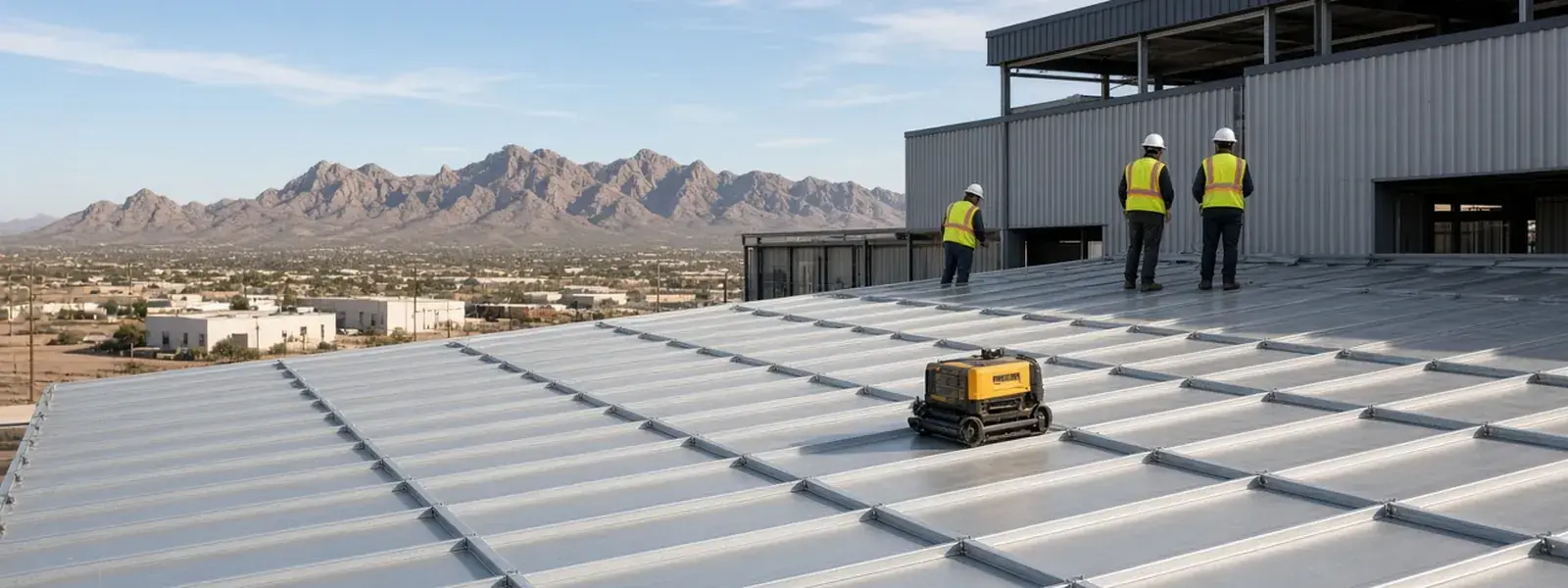
Metal on an East Valley commercial building moves. A 100-foot standing-seam run can grow the better part of an inch between a January dawn and a June afternoon. If the clips cannot float, if the panel is through-fastened like a barn, or if the seamer skipped a lock, that movement becomes oil-canning, elongated holes, and a leak at the eave. Property managers call when fasteners back out, when a monsoon finds a lap, or when they are tired of coating a tired R-panel every five years. Scottsdale Commercial Roofers installs and details commercial metal roofing for Scottsdale heat: floating clips, PVDF finishes, and flashings that let the panel grow without opening a hole. The goal is a roof that moves on purpose, not one that works a washer until it leaks.
What this job includes
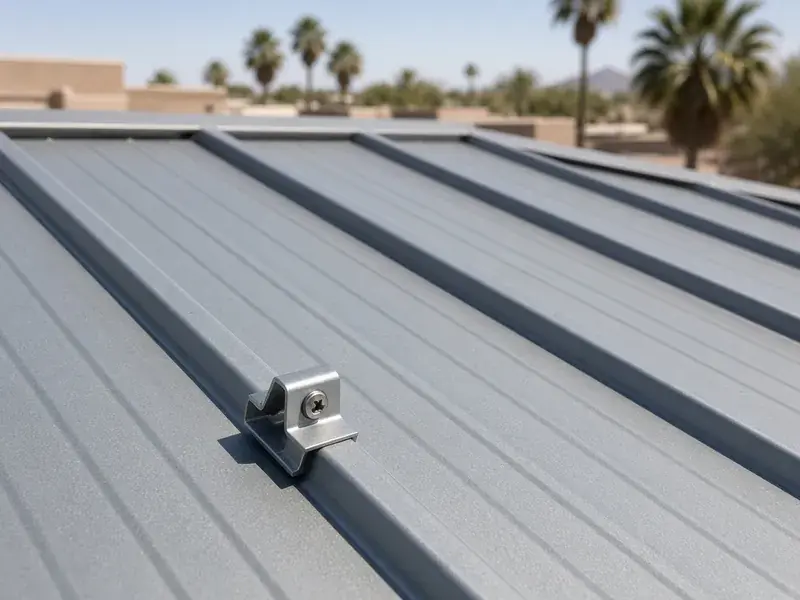
- Standing-seam panels on floating clips sized for thermal movement, not fixed bars
- Galvalume AZ50 or AZ55 substrate with a PVDF (Kynar-class) finish where color matters
- Clip spacing and seam type checked against wind uplift and FM 1-90 when required
- Z-closures, butyl tape, and hemmed eaves that do not rely on exposed mastic
- Pipe boots and curb flashings detailed for panel movement, not a stiff pitch pocket only
- Through-fastener audit and retrofit on existing R-panel and corrugated when replacement is not due
- Oil-canning control: tension-leveled coil, correct clip reveal, and no over-pulled fasteners
- Ridge, hip, and transition flashings with two-piece designs that can slide
- Fall-protection anchors and walk pads that do not puncture the seam
- Cut-edge paint and touch-up only where the finish was actually cut, never as a field coating fake
When this is the right call
Screws are backing out of an R-panel field
Through-fastened metal in this climate works the neoprene washers every day. UV cooks them. Thermal cycling elongates the holes. Once a row is pumping, monsoon water follows the screw into the deck. That is a fastener and lap problem before it is a “new roof” problem.
Panels are oil-canning and tenants can see it
Oil-canning is a coil and clip issue more than a leak, but it is also a sign the panel is stressed. On street-facing office metal it becomes a complaint. We look at gauge, clip type, and whether someone fastened through the flat.
You want to stop recoating a tired metal roof
Acrylic on old Galvalume is a maintenance cycle. If the substrate is still sound, a high-build restoration coating can buy time. If the laps are open and the steel is thinning, you are in panel replacement, not another spray day.
A standing-seam lock is unseated after wind
Monsoon outflows and dust storms pry a lazy lock. If the seamer never finished the snap or the mechanical lock, uplift starts there. We reseam what we can and replace panels that have a stretched male leg.
Rooftop solar or HVAC is fighting the panel
S-5 type clamps belong on the seam, not in the flat. If a past solar crew drilled the pan, you now have a through-fastener roof wearing a standing-seam costume. We correct attachments before the next leak map writes itself.
How the work actually runs
Move 1
Read the existing metal and the structure
We identify panel profile, gauge, clip type, and whether the roof is structural or over solid deck. We check fastener rows, rust at cut edges, and how the building wants to drain. Slope matters. Metal is not a fix for a dead-level commercial deck.
Move 2
Design for movement and uplift
Clip type and spacing come from thermal length and wind. Floating clips are the default on long Scottsdale runs. Fixed clips belong only where the manufacturer’s thermal table allows. Perimeter zones get the denser pattern FM 1-90 style jobs expect.
Move 3
Set underlayment and the panel layout
High-temp underlayment goes down on solid deck. On open-purlin structural metal we follow the panel’s structural tables. Panel lengths are planned so eave and ridge details can slide. We do not force a 140-foot sheet if the job needs a controlled expansion joint.
Move 4
Install clips, panels, and two-piece flashings
Clips go to layout. Panels lock and get seamed to spec. Butyl and closures stay in the designed joint, not smeared as a rescue. Curbs get an upper pan and a lower pan that can move. Pipes get boots rated for the panel temperature range.
Move 5
Seam check, fastener audit, and rinse protocol
We walk locks, check exposed fasteners with a torque pattern that does not crush washers, and clean metal fines so they do not rust-stain Galvalume. You get a panel map and photos of clip rows and transitions.
Why this crew for commercial metal roofing
Thermal clips, not barn screws
Desert metal lives or dies on whether the panel can grow. We design clip systems for 30F to 175F surface swings. Through-fastening a long commercial run is how you elongate holes by year four.
Finish systems that belong in this UV
PVDF finishes hold color. Cheap polyester chalks. Galvalume has a real cut-edge behavior we respect. We specify the coil, we do not treat “metal” as one product.
Uplift patterns for monsoon wind
July outflows peel lazy perimeters. Clip density and seam type are written to the wind, not to a residential metal brochure.
Honest repair versus reroof
We will re-fasten, reseam, and restore a sound R-panel. We will also tell you when the steel is too thin and coating is theater.
Commercial crew, commercial staging
Panel hoisting, seamer operation, and fall protection on a steep or high eave are licensed and insured commercial work. A professional crew treats the lot and the interior as occupied.
Standing seam is a clip system first. The seam is how you hide the fastener and let the panel slide. In Scottsdale the slide is not theoretical. Light-gauge steel and aluminum grow enough on a long run that a fixed clip will either oil-can the pan or tear a hole at the eave. We use floating clips and two-piece flashings so the ridge and the wall do not become the expansion joint by accident. If a prior installer locked the panel at both ends, we treat that as a movement failure waiting on the next June afternoon.
Through-fastened R-panel and corrugated still cover a lot of East Valley warehouses and older retail. Those roofs can be maintained. Washer replacement, stitch-screw programs, and lap butyl are real work. They are not permanent if the holes are already slotted. Once the fastener walks in an oval, you are chasing leaks every monsoon. That is when we talk panel overlay or a standing-seam recover on hat channels, not another bucket of lap sealant. A fastener audit with a torque pattern takes a day and tells you which fork you are on.
Oil-canning gets blamed on “cheap metal.” Sometimes it is. Sometimes it is a 24-gauge panel pulled down on an uneven clip row, or a through-fastener in the flat, or a coil that was not tension-leveled. On a visible office canopy it matters. On a warehouse field it is cosmetic unless it is a stress sign. We say which is which so you do not buy a full reroof to chase a reflection. A wide architectural pan in this sun will never look like a glass table, and we will tell you that before you spend the elevation budget.
Coatings on metal are chemistry plus surface prep. Acrylics are cheaper and recoat more often. Silicones handle ponding better if the metal roof has low spots, which a true slope should not. Either one fails if you spray over rust bloom, oil, or failed washers. We treat restoration coating as a maintenance system with a wash, a rust primer where needed, and fastener replacement. We do not paint over pumping screws and call it done. If the steel is thinning at laps, coating is a delay you should budget as a delay.
Rooftop equipment is where metal roofs leak even when the field is perfect. Curb flashings must step with the panel, not fight it. Solar attachments belong on the seam. Evaporative cooler curbs on older metal buildings often sit on sleepers that trap water. We rebuild those details as metal work, not as a pitch pocket sitting in a pan that was never meant to hold sealer in 175F sun. A pourable pocket in a standing-seam pan is a maintenance item that will be back on your list every summer.
Where this work goes
We run commercial metal roofing across Scottsdale and the East Valley. For the full city list, open Where We Work. Priority walks after Scottsdale are Phoenix, Mesa, Tempe.
If your Scottsdale metal roof is walking fasteners, oil-canning, or leaking at a curb, call Scottsdale Commercial Roofers. We will read the panel, the clips, and the thermal length, then tell you whether a fastener program, a restoration coat, or a standing-seam replacement is the honest next step. Bring the last leak map if you have one. We will walk the same path in daylight.