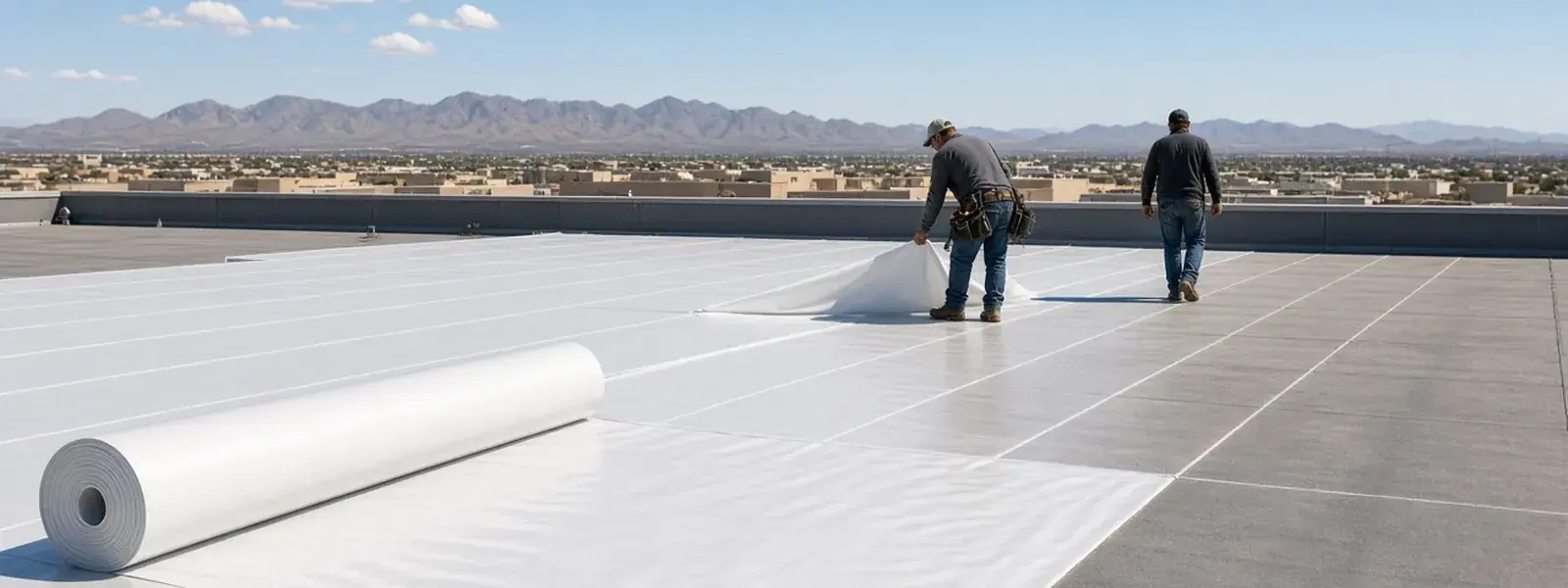
TPO fails in the Sonoran Desert for two reasons more than any other: cold welds and a sheet that was never detailed for 175F surface temps. You see it as a wrinkle at a T-joint, a probe that sinks into a glossy but weak lap, or a membrane that shrinks and pulls off the parapet. Property managers like TPO because it is white, weldable, and familiar to every HVAC tech who walks an East Valley roof. That only helps if the crew ran a real weld window, picked the right mil, and put cover board under the sheet. Scottsdale Commercial Roofers installs thermoplastic polyolefin to ASTM D6878, with probed seams and attachment that matches the deck, not a generic takeoff.
What this job includes
- 60-mil or 80-mil ASTM D6878 TPO, fleece-back where the deck or recover needs it
- Hot-air welding with documented temperature, speed, and nozzle setup for that day’s sheet
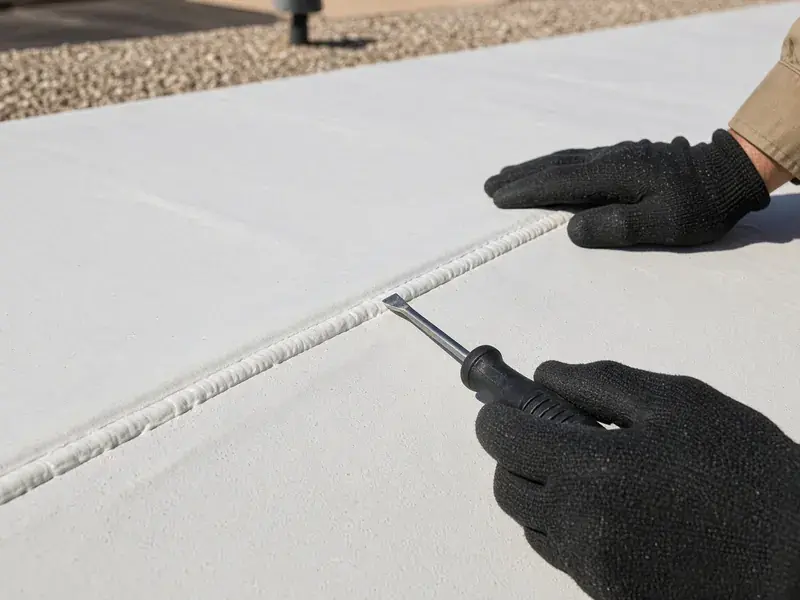
- Seam probing of field laps, T-joints, and flashing boots before demobilization
- Cover board under the membrane at the field, plus extra at perimeters and corners
- Mechanical, fully adhered, or induction-welded attachment matched to pullout values
- SRI-rated white sheet aimed at cooling load, not just a bright look from the lot
- Prefabricated inside and outside corners, not hand-cut patches that star at the fold
- Walkway pad at RTU service sides, roof hatches, and condensing-unit paths
- New pipe boots, pitch-pocket rebuilds, and clamp-ring drain flashings in TPO
- Perimeter enhancement fastening to FM 1-90 patterns when the project calls for it
When this is the right call
A probe sinks into a “finished” weld
A TPO lap can look shiny and still be a cold weld. If a seam probe drops into the membrane instead of riding the bead, that lap will open on the next hard thermal cycle. That is a workmanship problem, and it is common on rush summer installs.
The sheet is shrinking at the parapet
Underspecified 45-mil or a poorly attached field will pull. In Scottsdale heat the sheet wants to move. If the termination bar is the only thing holding the perimeter, you will see bridging and open corners by year five.
You want a cool roof that HVAC can live with
White TPO with a real SRI listing cuts roof-surface heat and helps aging RTUs. Property managers feel it in summer demand charges. It only stays white and reflective if drainage works and the sheet is thick enough to take traffic.
You are covering a cut-up recover
Fleece-back TPO over cover board is how you hide an ugly but dry substrate without printing every fastener and every old wrinkle through an 80-mil face. If the old roof is wet, fleece-back is not a magic carpet. Tear it off.
Induction plates are popping in the field
Induction-welded TPO is clean when the plates are set to the right energy and the deck holds the screw. If plates release in monsoon wind, you have an attachment failure, not a membrane failure. We test pullout before we repeat that pattern.
How the work actually runs
Move 1
Confirm sheet, mil, and attachment
We pick 60 or 80 mil from traffic, weld history on that manufacturer, and how cut-up the roof is. Attachment is mechanical, adhered, or induction based on deck pullout, building height, and FM or manufacturer tables. Fleece-back is a recover tool, not a default.
Move 2
Set the weld window for that day
TPO weld quality is temperature, speed, and clean dry laps. A June roof in Scottsdale can be too hot by 11 a.m. We shade, wipe, and adjust the welder instead of forcing a 1,000-degree nozzle across a dusty sheet. That window is written down, not guessed.
Move 3
Lay cover board and the field
Cover board goes down first. Sheets are placed to shed laps away from drains where the pattern allows. Perimeter and corner fastener density goes up. We do not starve the edges to save plates. Monsoon uplift starts at the perimeter.
Move 4
Weld, probe, and flash every penetration
Field laps get an automatic welder. Details get a hand welder. T-joints get extra attention because three sheets meet and hide a void. Boots, corners, and drain targets are prefab where we can. Then the whole seam map gets probed.
Move 5
Terminate, water-test, and photograph
Parapets are wrapped or barred and counterflashed. Walk pads go at the real service paths, not a decorative strip by the hatch. We water-test drains and historic leak points and leave you a photo set of welds and plates.
Why this crew for tpo roofing
Weld window discipline
We treat TPO like a thermoplastic, because it is one. Dirty laps and a rushed automatic welder are the number-one TPO failure we tear off in the East Valley. Probing is not optional on our jobs.
Mil thickness for this sun, not a catalog minimum
45-mil might pass a mild climate spec. It is a thin bet under 175F surfaces and HVAC traffic. We push 60 and 80 mil because the desert eats the top ply and the weld zone.
Attachment that matches pullout
A beautiful weld over screws that spun in lightweight concrete is still a failed roof. We test the deck and then choose mechanical, adhered, or induction. FM 1-90 patterns are used when the building or the carrier expects them.
Cool-roof sheet with drainage behind it
SRI only helps if the sheet stays clean enough and water leaves. We will not sell a white TPO recover over known ponding and call it an energy upgrade.
Details a roofer’s welder can repeat
Prefab corners, real boots, and walk pads at the units people actually service. Licensed and insured crew, not a residential team “helping out” on a 40,000-square-foot field.
ASTM D6878 is the TPO product standard. It does not install the roof. Thickness, reinforcement, and formulated UV package get you a sheet that can live in Arizona. The install is about weld energy and cleanliness. A lap needs a consistent bleed-out and a bead you can probe. If the crew is welding over talc, dust, or a morning monsoon film, you get a cosmetic seam. Those seams open when the sheet shrinks on the first cool October night after a brutal summer.
Solar Reflectance Index matters on East Valley low-slope because the roof is a heat sink sitting on leased space. A CRRC-listed white TPO drops surface temperature versus aged gray mod-bit or bare SPF. That helps RTUs and the people under a weakly insulated deck. Reflectance fades if ponding leaves mineral rings and if foot traffic grinds the top ply. Drainage and walk pads are energy details, not extras. If the sheet is sitting in a birdbath by August, you bought a reflective pond, not a cool roof, and the HVAC relief you wanted never shows up on the bill.
Fleece-back TPO is the right recover membrane when the old roof is dry and ugly. The fleece hides telegraphing and gives the adhesive or the plate a thicker target. It is the wrong product if cores come up wet. Trapping moisture under a new vapor-tight sheet in this heat cooks the old iso and gives you blisters you will be cutting out next monsoon. We core first. A recover bid that skips moisture work is just a nicer way to seal last year’s leak into the sandwich.
T-joints and inside corners are where desert TPO jobs come apart. Three thicknesses meet. The automatic welder cannot see that void. A hand welder and a roller have to build a step that the probe respects. We also watch membrane direction at parapets. If the sheet is asked to make a sharp pull over a sharp edge with no cover-board chamfer, it will thin and split on the thermal cycle. Those splits show up as hairline leaks after the first cool October night, and they are easy to miss on a drive-by inspection.
Wind in a July outflow can hit a Scottsdale roof harder than people expect. Uplift starts at perimeters, corners, and around large RTU curbs. That is why fastener rows tighten there and why a peeled edge becomes a peel-stop emergency by morning. TPO is a good membrane in this market when the attachment pattern is honest. It is a kite when the bid starved the plates. We would rather explain a denser perimeter on the bid than explain a peeled bay after the first dust storm.
Where this work goes
We run tpo roofing across Scottsdale and the East Valley. For the full city list, open Where We Work. Priority walks after Scottsdale are Phoenix, Mesa, Tempe.
If you want TPO that is welded to the day, not just rolled out white, call Scottsdale Commercial Roofers. We will check mil, deck pullout, and the seams you already have. Then we will tell you if a repair, a recover, or a tear-off is the grown-up path for that Scottsdale roof.