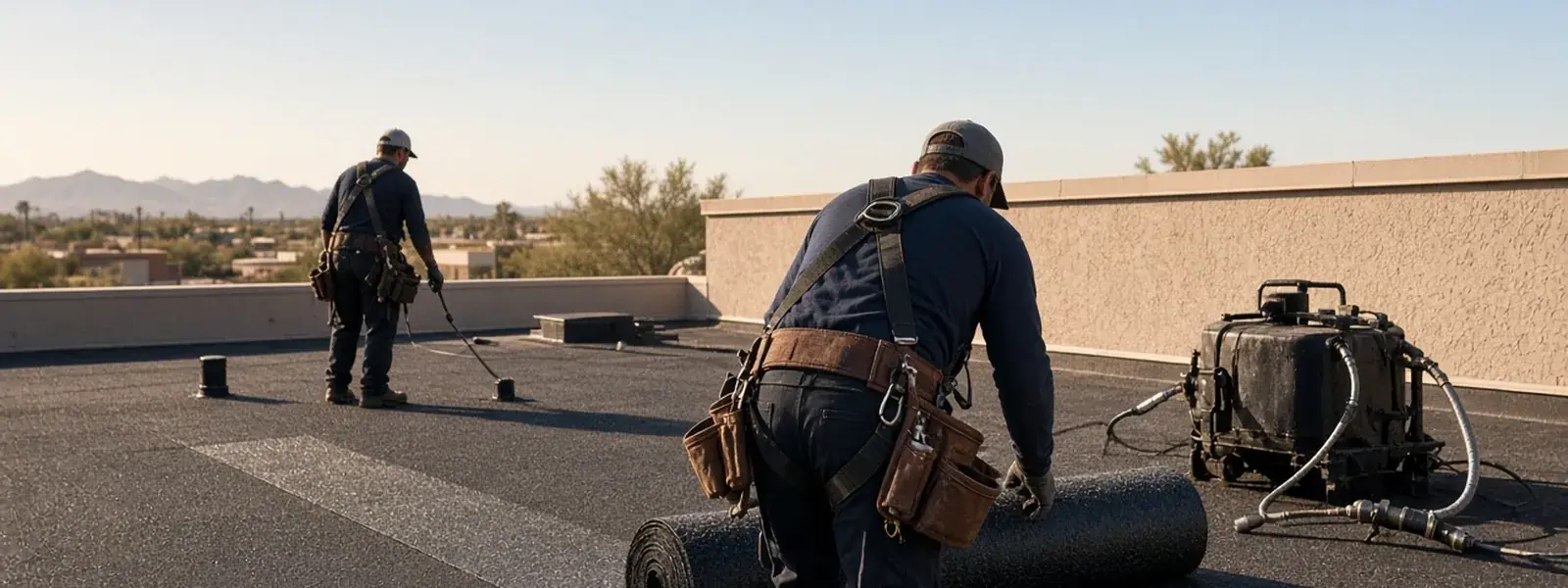
Modified bitumen still earns its keep on Scottsdale commercial roofs that take abuse: small sections, high parapets, kitchen exhaust zones, and recover strips where a welder is the wrong tool. SBS stays flexible through the 30F to 175F surface swing. APP likes a torch and a crew that knows when the sheet is actually ready, not just shiny. The failures we tear off are thin cap sheets with the granules gone, cold laps on a torch job, and self-adhered base that was set on a 160F deck and melted itself into a wrinkle. Scottsdale Commercial Roofers installs SBS and APP systems with a real base ply, a cap that can take this UV, and flashings that are not a mop of leftover mastic.
What this job includes
- SBS or APP cap sheet selected for the section, not one product forced onto every roof
- Base ply plus cap (split-sheet) on the field, not a single-ply “mod-bit” shortcut
- Torch, cold-adhesive, or mopping method matched to occupancy and fire rules
- Granule-surfaced cap or a UV-stable coating where a smooth APP needs protection
- Base flashings at parapets with termination bar and counterflashing, not a cant strip only
- Pitch-pocket rebuilds and clamp-ring drain flashings in compatible modified sheets
- Bleed-out control at laps so you can see fusion without rivers of asphalt on the wall
- Self-adhered products used only inside their temperature window, which is narrow here in summer
- Walk pads or extra cap at HVAC paths where granules will grind off first
- Core-out of wet felts before a recover so we are not capping a sponge
When this is the right call
Granules are in the scuppers, not on the sheet
UV and monsoon water strip a tired cap. Once the asphalt is bald, the sheet cooks faster. That is a re-cover or a coating decision if the base is still stuck. It is a tear-off if the felts below are wet and rotten.
A torch job has open laps and a fishmouth
APP that never saw enough heat at the lap will open on the first cool night. Fishmouths are not cosmetic. They are a water path. We cut, torch in a patch that bonds, or we replace the bay if the pattern is everywhere.
You need a tough roof on a small, cut-up section
A 4,000-square-foot office wing with twenty curbs can be a better mod-bit job than a TPO puzzle of boots. SBS handles the abuse. We still detail drains and parapets like a commercial roof, not a shed.
Self-adhered base wrinkled in July
Peel-and-stick likes a temperature window. A Scottsdale roof at 2 p.m. can be outside it. If a prior crew set SA base on a frying-pan deck, you get voids. We wait for the window or we change methods.
Kitchen or exhaust grease is killing the cap
Grease and modified bitumen are a bad marriage. We isolate those zones with walkway, a grease-resistant detail, or a different membrane in the fall radius. Recoating grease into the field is how the next leak starts.
How the work actually runs
Move 1
Identify the existing bitumen system
We core for ply count, mop versus torch, wet felts, and whether you already have two roofs. SBS and APP are not interchangeable at the repair level. The patch has to match the chemistry and the method that is already up there.
Move 2
Pick SBS or APP and the application method
SBS with cold adhesive or hot mop is the usual occupied-building choice. APP torch-applied is fast and tough when fire watch and occupancy allow it. We will not torch over a combustible deck sandwich to save a day.
Move 3
Set base ply and flashings first
Split-sheet means the base ply builds the field and the flashings before the cap hides them. Cants, termination bars, and drain targets happen at this stage. A cap-only job is how corners peel in year three.
Move 4
Set the cap with a readable bleed-out
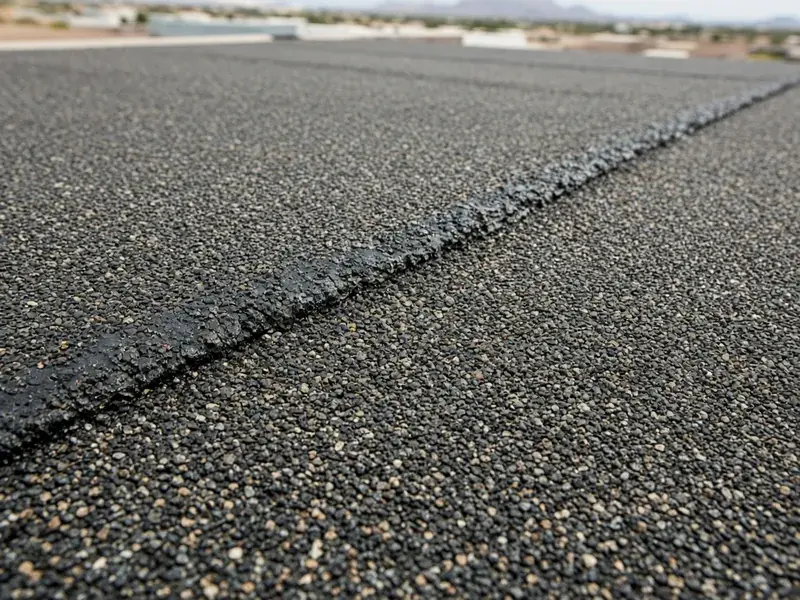
Laps need a consistent bleed, not a starved dry edge and not a flood that hides a void. Granule embed at the lap is checked. We work the sheet into the 30F to 175F reality of this climate, which means morning torch work in high summer.
Move 5
Terminate, coat if specified, and water-test drains
Counterflashing goes back. Smooth APP gets its UV coat if that was the spec. Drains and scuppers are water-tested. You get photos of bleed-out and flashing height, which is the quality record on a mod-bit job.
Why this crew for modified bitumen roofing
Split-sheet, not a one-ply shortcut
Base plus cap is how modified bitumen is supposed to be built. A single thin cap over a questionable recover is a sales number, not a system.
Method matched to the building
We torch when it is safe and smart. We go cold or mopped over occupied offices and near combustible details. The membrane does not get to pick a method that endangers tenants.
SBS flexibility for desert cycling
SBS stays workable through the daily thermal swing. That matters at parapets and around RTU curbs that move. APP has its place. We do not pretend they behave the same at 6 a.m. in January.
Granule and UV honesty
A bald cap in this sun is on a clock. We will re-cap, coat, or tear off based on what the base is doing, not based on how the roof looks from the lobby.
Flashings a property manager can inspect
Termination bar, counterflashing, and a bleed-out you can see. Licensed and insured commercial work with a professional crew, not a mastic artist on a ladder.
SBS and APP are both “mod-bit,” and they are not the same install. SBS is asphalt modified with styrene-butadiene-styrene. It stays flexible and likes adhesive or mopping. APP is atactic polypropylene. It likes a torch and a glossy bleed. Mixing a torch patch onto an SBS field without a compatible sheet is a common East Valley repair mistake. We match the patch to the system that is already on the roof. If nobody can tell you what is up there, we core it before we light a torch or open a pail.
Split-sheet application is the grown-up way to build these roofs. The base ply is the waterproofing skeleton. The cap is the UV and traffic layer. Skipping the base to “save a ply” shows up at every inside corner and every drain. In monsoon water, that missing ply is the difference between a slow stain and a dry deck. We would rather explain a second ply on the bid than explain why the corners peeled after the first full summer of thermal cycling.
Torch work in Scottsdale has a daily clock. By late morning the sheet and the deck can be so hot that the installer loses the read on when the APP is ready. That is how you get scorch on the top and a cold lap underneath. We torch earlier, we use a fire watch, and we will switch a section to cold-applied SBS if the occupancy or the deck sandwich says a flame is the wrong tool. A fast torch day that ignores the deck assembly is not a savings. It is a risk you do not need.
Self-adhered modifieds are popular because they feel safer than a torch. They have a narrow temperature window. A 175F roof surface can over-soften the adhesive and trap voids. A winter dawn can be too cold for bond. We use SA when the day is in range and the substrate is primed and dry. We do not peel plastic on a frying pan because the schedule said so. If the window is gone, we stop or we change methods rather than bury wrinkles under a cap.
Granule loss is the visual that brings most property managers to the parapet. Some loss is normal. Sheets of bald asphalt with granules in the drain bowl are not. Once the cap is UV-naked, the weather side ages fast. A reflective coating can protect a still-bonded smooth or bald cap. It cannot glue a rotten felt back to a wet deck. Cores keep that conversation honest. We will coat a living cap and we will replace a dead one, and those are not the same invoice.
Where this work goes
We run modified bitumen roofing across Scottsdale and the East Valley. For the full city list, open Where We Work. Priority walks after Scottsdale are Phoenix, Mesa, Tempe.
If your Scottsdale roof is a tired cap sheet, an open torch lap, or a small commercial section that needs a tougher membrane than a thin TPO puzzle, call Scottsdale Commercial Roofers. We will core it, name the system, and install SBS or APP the way a split-sheet job is supposed to be built.