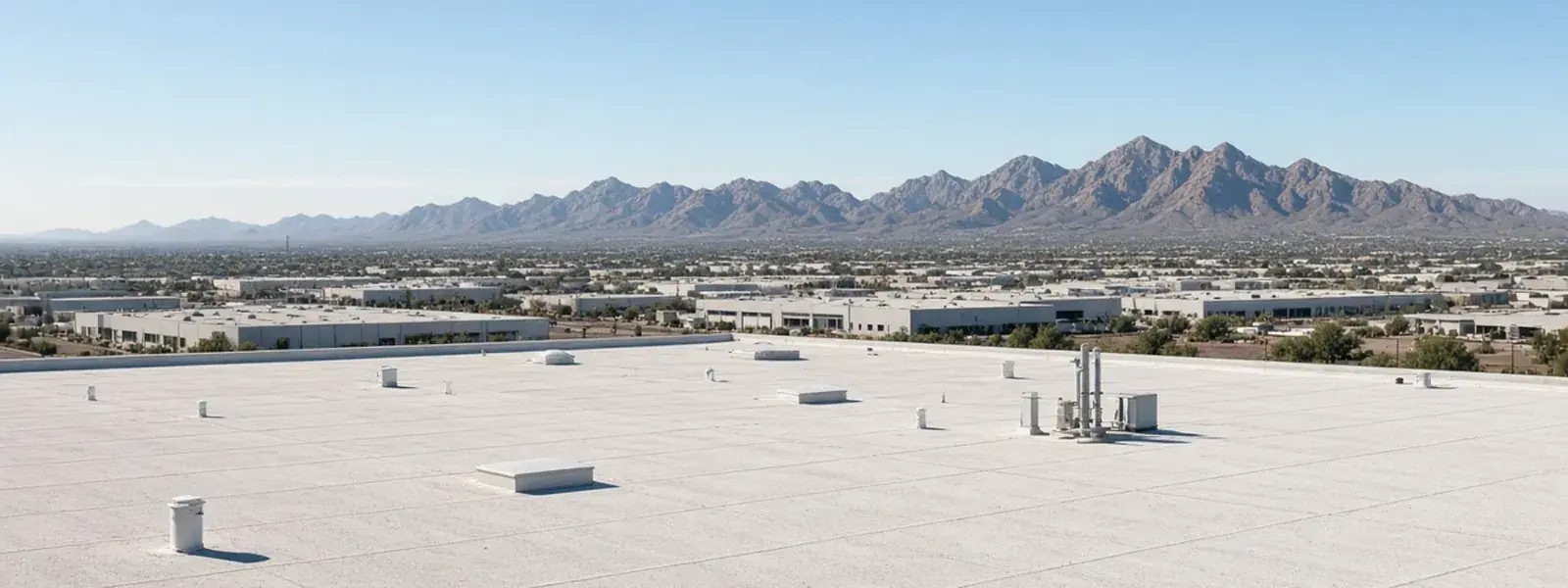
A warehouse roof in the East Valley is acreage. Long drainage runs, a metal deck that telegraphs every flute, skylights that have been leaking since the last monsoon, and RTUs or evaporative coolers spotted across a field you measure in squares, not bays. Inside, pick lines and racking do not stop because the roof is open. A drip over cardboard is a different phone call than a drip over a desk. Scottsdale Commercial Roofers roofs warehouses as production-adjacent work: interior drip protection, fastener patterns that hold in monsoon outflow, and drainage that can carry a 20-minute cell the length of the building without parking a pond at column line J. If receiving has to keep moving, the roof plan has to respect the dock schedule.
What this job includes
- Large-field takeoff with drain and scupper capacity checked against monsoon burst rates
- Tapered iso or crickets on long low-slope runs so water does not stall mid-bay
- Cover board over metal deck so the membrane does not print every flute and fastener
- Skylight and smoke-vent reflash or replacement while the field is open
- RTU and cooler curb details with crickets on the upslope side of wide units
- Interior protection over racking, cardboard, and production lines during tear-off
- FM 1-90-style field and perimeter fastening when the account or the wind design wants it
- Night-seal plan sized to warehouse squares, not to a 5,000-square-foot office wing
- Walk pads and designated HVAC paths so techs stop grinding random shortcuts
- Staging from dock-high or crane picks that does not block every truck door
When this is the right call
Water is staining product or the pick aisle
Warehouse leaks are inventory leaks. We put catchments up first, then find whether it is a skylight, a drain, or a traveling flute. Waiting for a “slow season” is how you write off another row of cardboard.
Skylights are brittle and the gaskets are gone
Desert UV cooks plastic skylights. They crack, they chalk, and they leak around curbs that were never flashed to the new recover. Replacement during a reroof is cheaper than another year of buckets in aisle 4.
The field ponds in the middle of a 400-foot run
Long warehouses starve the last drain. Structure was poured or framed flat. Without taper, monsoon water sits over the same racking every July. Replacement is the moment to put slope in the insulation.
Fasteners are backing out of a through-fastened metal roof
A lot of East Valley warehouses are still R-panel. Washers fail, holes oval, and the next outflow peels a lap. We can run a fastener program or we can go to a membrane or standing-seam recover on hat channel. The steel thickness decides.
Operations cannot stop for a reroof
They should not have to. We phase squares, protect interiors, and work dock schedules. Warehouse roofing that shuts receiving is a failed project even if the welds are pretty.
How the work actually runs
Move 1
Measure the watershed and the operations map
We shoot drains, note low flutes, and walk the interior for stain, racking, and what cannot get wet. The roof plan and the production plan are the same document. If aisle 12 cannot take a drip, that bay is not a Monday tear-off.
Move 2
Set attachment for metal deck and wind
Pullout on metal deck is usually honest if the flute and the screw match. Lightweight fills and old recover layers are not. Perimeter and corner density follows FM-style patterns on big, open roofs because monsoon wind has a lot of sheet to grab.
Move 3
Build slope on a long, flat structure
Tapered polyiso, saddles, and crickets are how a 200,000-square-foot field drains. We will not recover dead-level and hope the existing drains “pull.” Drain bowls get lowered or added if the hydraulic run is too long.
Move 4
Phase tear-off over protected interiors
Openings are sized to night-seal capacity. Plastic and boards go over product. Skylights that are coming out get temporary lids. A professional crew treats the warehouse floor like it is still making money, because it is.
Move 5
Reflash equipment and close the squares
Curbs, vents, and new skylights get flashed as we go so we are not living on night seals for a month. Seams are probed. Drains are water-tested in sections. You get a square-by-square photo log, not a single pretty drone shot.
Why this crew for warehouse roofing
Acreage drainage, not office detailing copied large
Long runs need taper and drain capacity sized for monsoon cells. We design the watershed. We do not sprinkle extra scuppers and hope.
Operations stay open
Phased squares, dock-aware staging, interior protection. A warehouse reroof that blocks every truck is a different kind of leak.
Skylights and curbs in the base bid
The field is cheap. The holes are the job. We price skylight and RTU work up front so you are not change-ordered in week three.
Attachment for open, windy fields
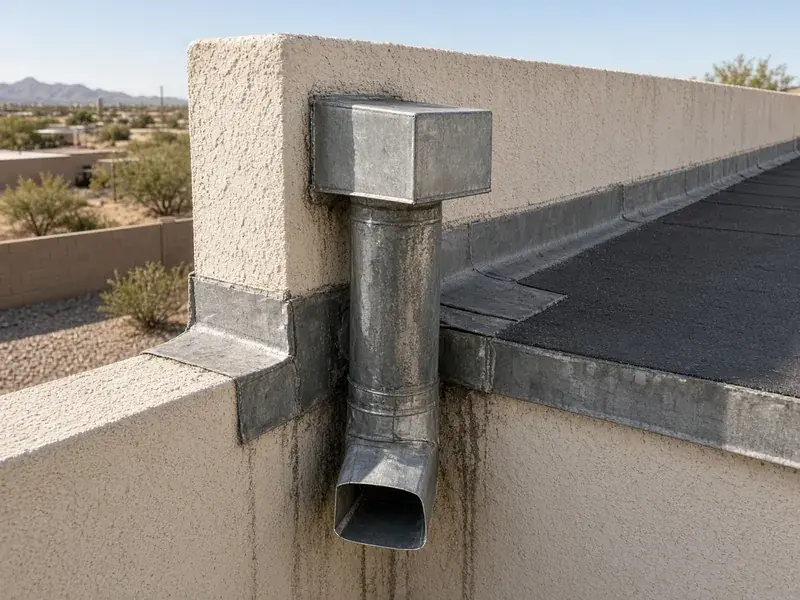
Big roofs peel at edges. FM-style enhancement and honest pullout keep the sheet on the deck when a July outflow hits the parapet.
Licensed and insured warehouse crews
Fall protection on open decks, a professional crew, and fast response if a night seal takes weather. This is industrial roofing over live product.
Warehouse drainage is a hydraulics problem disguised as roofing. A 20-minute Scottsdale monsoon can put more water on a 200,000-square-foot field than the primary drains were thought through for in 1994. Leaders choke. Overflow scuppers sit at the parapet while the pond is 80 feet inland. We model the run, add taper, and sometimes add drains. A new membrane that follows the old low point is a new pond over the same inventory. If the low point sits over racking, that is a capital problem, not a mop problem.
Metal deck telegraphing is why warehouse TPO looks wrinkled two summers later if you skip cover board. The flute pattern prints. Fastener heads print. HVAC techs walk the print into failures. Cover board costs money on acreage. It is still cheaper than a field that cannot be walked in July. We put it in the spec and we will show you a core from a warehouse that skipped it. A soft field on a 175F afternoon is how a “finished” roof starts taking callbacks before the first summer is over.
Skylights are a warehouse specialty whether anyone writes them into the first email or not. UV-brittle domes, failed gaskets, and curbs that were never tied into the last recover are standard East Valley conditions. If we are replacing the field, we want those curbs in the same mobilization. Temporary lids keep the floor dry. New units get flashed to the new membrane, not back to a 15-year-old boot. Leaving forty tired domes in a new field is how aisle 4 stays on the leak list.
Through-fastened metal warehouses are a different fork. If the Galvalume is still thick and the holes are still round, a fastener and lap program plus a restoration coating can be the capital-smart move. If the panels are thin and the laps are pumping, we look at a membrane recover on hat channel or a standing-seam overlay. Coating over slotted holes is how you get to meet again next monsoon. A fastener audit with a handful of pulled screws tells you which fork you are standing on.
Interior protection on a live warehouse is not a roll of plastic from the truck. It is who owns the aisle, what the product is worth, and whether a night cell can sit on a night seal over cardboard. We write that into the daily opening. If operations needs a bay, that bay stays closed on the roof. Replacement still happens. It happens like the building is a working machine, not an empty box. The roof schedule follows the dock schedule, not the other way around.
Where this work goes
We run warehouse roofing across Scottsdale and the East Valley. For the full city list, open Where We Work. Priority walks after Scottsdale are Phoenix, Mesa, Tempe.
If your Scottsdale or East Valley warehouse is ponding, dripping on product, or due for a field replacement you cannot shut receiving for, call Scottsdale Commercial Roofers. We will shoot the drains, map the skylights, and phase the squares so the roof changes and the operation does not. Tell us what aisle cannot get wet. That is where the daily opening plan starts.