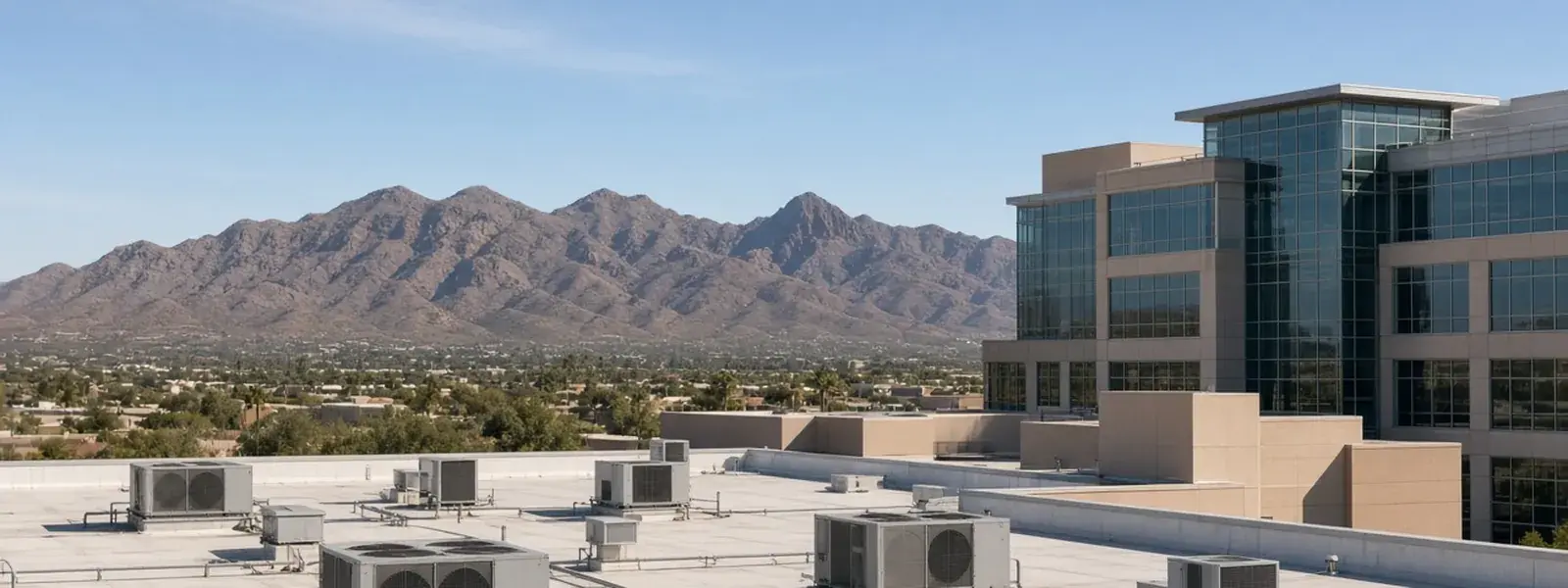
An office roof in Scottsdale is a small industrial plant sitting over people who are trying to take calls. RTUs, condensate lines, evaporative cooler curbs on older East Valley stock, satellite trays, and a parapet every tenant can see from the parking garage. The membrane has to handle 175F surfaces and monsoon bursts. The job has to handle occupied floors, elevator reservations, and a property manager who cannot shut the building down on a Tuesday. Scottsdale Commercial Roofers roofs office buildings as occupied projects: low-odor methods when we can, after-hours tear-off when we must, and curb flashings that survive the next HVAC change-out, not just the inspection photo. If a leak is over a workstation, we treat that as an occupied emergency before we talk about a capital reroof.
What this job includes
- Occupied-building work plan: interior protection, elevator and loading-dock staging, tenant notices
- After-hours or weekend tear-off windows when the deck must open over leased suites
- Low-odor adhesive options on TPO or SBS when daytime occupied work is required
- RTU and cooler curb flashings rebuilt to a height HVAC can work without shorting the skirt
- Condensate and cooler-dump lines traced so “roof leaks” that are HVAC water get named
- Parapet wrap or clean termination-bar lines on street-facing and garage-facing walls
- Walk pads at every service side, not a token strip at the hatch
- Quiet protocol around conference-heavy floors when we can shift noisy tear-off
- Tapered insulation and drain work so ponding does not sit over a law firm’s ceiling
- Photo documentation for ownership and for the next HVAC contractor who opens a curb
When this is the right call
Tenants are reporting stains over workstations
Office leaks are political. A drip over a desk is a faster phone call than a warehouse birdbath. We treat those as occupied emergencies: interior protection first, then source tracing, then a repair or a bay replacement that does not smell up the floor all week.
The roof is a maze of RTUs and old cooler curbs
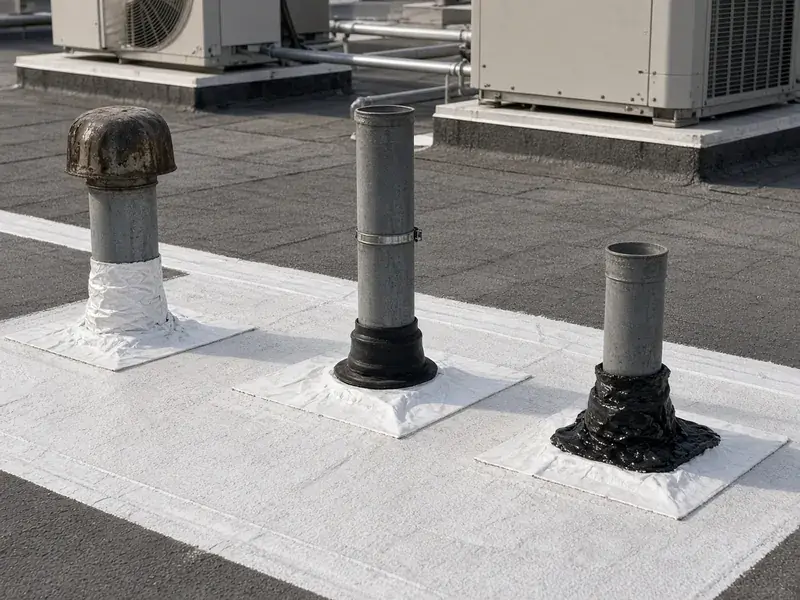
Scottsdale offices collect equipment. Every curb is a flashing. Every change-out is a leak risk. We reroof these as a penetration job, with cricket and height details, not as a pretty field with leftover skirts.
You cannot close the building for a reroof
You should not have to. We phase openings, use night seals, and shift torch or noisy tear-off off the conference calendar when the project allows. Office roofing is a logistics trade as much as a membrane trade.
The parapet looks tired from the street
Ownership cares about the elevation. A wrinkled wrap or a striped mastic parapet reads as a tired asset. We can make the termination clean without turning the job into a facade remodel.
A cool roof would help aging package units
White TPO with a real SRI listing drops surface heat over a low-rise office. That helps RTUs that are already on the edge in July. It still needs drainage. A reflective pond is a hot pond.
How the work actually runs
Move 1
Walk it with the property manager, not just the roof
We map suites under historic stains, HVAC shut-down limits, access hours, and where dumpsters can live without killing parking. The roof plan and the occupancy plan get written together.
Move 2
Choose methods the building can smell and hear
Adhered TPO or cold-applied SBS for daytime occupied wings. Torch and heavy tear-off shifted after hours when we can. Foam only if overspray and odor can be controlled around intakes. The membrane does not get to pick a method that empties the third floor.
Move 3
Protect interiors and open the roof in bites
Plastic and catchments go up over active stain zones. Tear-off openings match what we can dry in before tenants show up. Night seals are inspected like a deliverable, not like leftover felt.
Move 4
Rebuild curbs, drains, and the visible parapet
Every RTU and cooler curb gets a cricket and a flashing height HVAC can live with. Drains and scuppers are reset so a 20-minute cell does not enter a lobby soffit. Parapets are terminated clean for the elevation you actually photograph for leasing.
Move 5
Close-out with HVAC and ownership in the loop
Units get walked. Condensate is confirmed. You get a penetration map so the next change-out does not invent a leak. Punch is small because the occupied plan was the job, not an extra.
Why this crew for office building roofing
Occupied is the default, not a surprise
We plan elevator time, odor, and night seals as part of the spec. Office roofing that ignores tenants becomes a board-meeting roofing story.
Curb density is the real scope
The field is the easy part. We price and staff the RTU and cooler flashings like they matter, because they are where office roofs leak.
Cool-roof sheet with office HVAC in mind
White membranes and documented SRI help aging package units through Sonoran July. We still fix the drains. Comfort complaints and leak complaints often share a roof.
Clean parapets for leasing photos
A tidy termination is not vanity on a Scottsdale office. It is what brokers shoot. We can deliver that without a fake “architectural” upcharge speech.
Licensed and insured, professional crew
Badges, fall protection, and a crew that knows the lobby is not a staging area. Fast response when a tenant leak hits during the project.
Office buildings in the East Valley are roof-load museums. Original swamp-cooler curbs sit next to three generations of package units. Abandoned sleeper sets punch the membrane. Satellite masts share pitch pockets with electrical masts. A reroof that “covers the field” and steps around that clutter leaves you the same leak map with a new color. We treat the penetration schedule as the job. If a curb is abandoned, we remove it while the roof is open. That is cheaper than flashing a ghost forever.
Odor and noise are why office roofing gets a bad reputation. Hot asphalt and midday tear-off over a call center is how you get a stop-work from the biggest tenant. We use low-odor adhesives when the schedule is daytime. We shift torch and dumpster-loud tear-off to evenings when the project and the city noise rules allow it. That is not softness. That is how you finish the roof without a rent concession conversation. We would rather add a night shift than empty a floor of billable people.
Evaporative coolers still sit on a surprising number of older Scottsdale offices and mixed-use buildings. They overflow. They dump mineral water at the curb. They get service techs who walk the same path until the cap sheet is bald. We flash those curbs like wet equipment, add walk pads, and tell you when the leak is cooler dump rather than a membrane failure. Naming it saves you a roofing invoice for an HVAC adjustment. A wet pad and a short condensate line are mechanical problems wearing a roofing costume.
Parapets on office buildings are both a waterproofing edge and a visible elevation. Thermal cycling here works the coping, the reglet, and the termination bar every day. We re-secure coping, reset counterflashing, and wrap or bar the membrane so monsoon rain cannot ride the backside of the stucco. A clean line from the garage is a side effect of a tight detail, not a separate vanity scope. Leasing photos should show a straight coping, not striped mastic from the last three leak calls.
Access is a design constraint. Some Scottsdale offices have a single roof hatch and a freight elevator that the florist is using on Thursdays. Panelized insulation, roll sizes, and crane picks get planned around that. A crew that tries to walk 80-mil TPO up a finished stair will mark walls and lose the building manager by lunch. We stage like guests in a leased asset, because that is what it is. The lobby is not a laydown yard, and the garage needs its spaces back by morning.
Where this work goes
We run office building roofing across Scottsdale and the East Valley. For the full city list, open Where We Work. Priority walks after Scottsdale are Phoenix, Mesa, Tempe.
If you manage a Scottsdale office and the roof is leaking over tenants, or you are planning a reroof you cannot shut the building for, call Scottsdale Commercial Roofers. We will walk the curbs, the suites, and the access, then build an occupied-building roofing plan that keeps people at their desks.