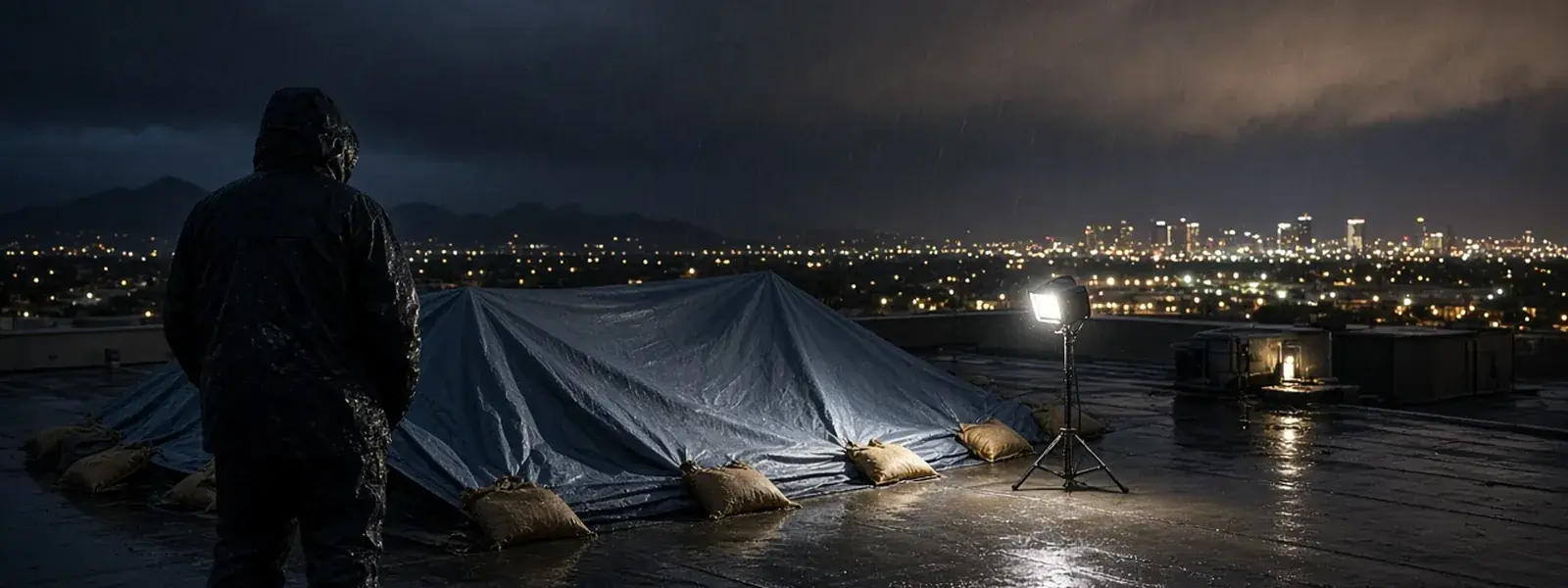
An emergency roof leak in Scottsdale rarely waits for a convenient Tuesday. A monsoon cell hits at 6 p.m., a clamp-ring drain backs up, and water is in the suite before the second band arrives. Or a TPO edge peels in an outflow and the sheet starts to run. Or an evaporative cooler overflows into a curb that was already tired. Property managers need someone who can dry the interior path, find the actual opening, and get a night seal on it before the next cell, not a voicemail and a mastic smear on the wrong lap. Scottsdale Commercial Roofers handles emergency roof leak repair as source tracing plus temporary dry-in, then a permanent detail when the substrate can take it. Fast response. Same-day service available.
What this job includes
- Fast response and same-day service available on active commercial leaks
- Interior protection first: catchments, plastic, and a path that keeps tenants out of the drip
- Source tracing from the stain upslope, including HVAC dump and cooler overflow
- Temporary dry-in: peel-and-stick night seals, peel-stop on running edges, drain ring resets
- Clamp-ring drain clearing and rebuild when the emergency is a choked bowl
- Parapet and scupper overflow checks after wind-driven monsoon rain
- Compatible emergency patches on TPO, mod-bit, metal, and foam, labeled as temp or permanent
- Photo log for ownership, insurance files, and the follow-up repair ticket
- A clear handoff from dry-in tonight to the welded or torched repair this week
- Weather watch so we are not opening a bay into the next cell
When this is the right call
Water is in the suite and another band is on the radar
That is a dry-in call, not a reroof conversation. We protect the interior, get on the roof, and close the opening that is feeding the drip. Capital planning happens after the floor is dry.
A membrane edge is flapping after outflow winds
Peel-stop is the emergency. If the sheet keeps running, you lose squares overnight. We terminate the tear, weight or fasten the edge, and come back into the bay when we can weld or adhere for real.
A drain is underwater and the overflow never engaged
Clogged clamp rings and high scuppers turn a 20-minute cell into an interior event. We clear, reset the ring if it is spinning, and open the overflow path. That is often the whole emergency.
An HVAC or cooler failure is dumping on the roof
Not every drip is a membrane hole. Cooler overflow and condensate can look identical from the lobby. We name it so you call the right trade after we dry the path.
You need a documented emergency for ownership
Photos, the water path, what we sealed, and what still needs a permanent detail. Emergency work without a paper trail becomes an argument. We write it down.
How the work actually runs
Move 1
Stabilize the interior
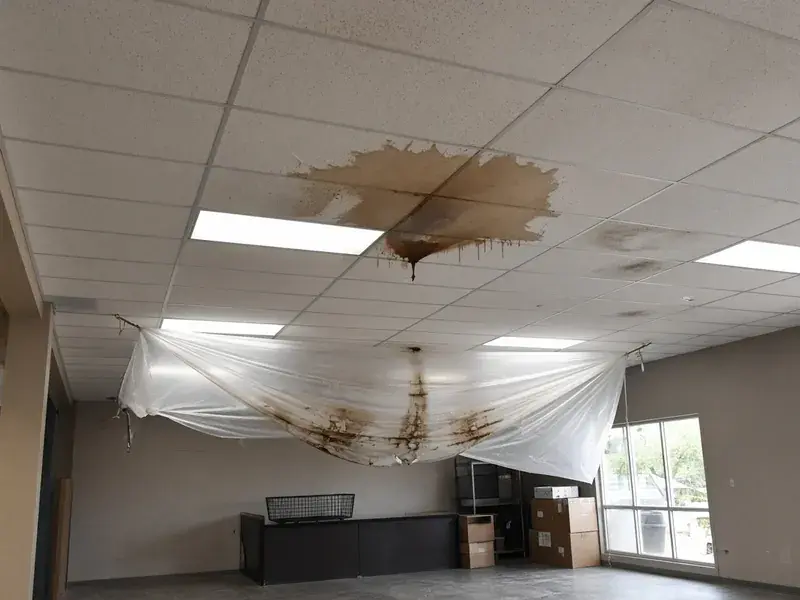
Buckets are not a plan. We set catchments, move what we can off the drip, and keep a walkable path. If the ceiling is holding water, we relieve it so it does not dump on a desk at 2 a.m. Then we go to the roof.
Move 2
Find the opening, not the first shiny lap
We work upslope from the stain. Drains, scuppers, curbs, cooler dump, and peeled edges get checked before we live on a random field patch. A hose test happens if the storm has passed and we still cannot see it.
Move 3
Dry-in with a method that can take the next cell
Peel-and-stick on a clean, dry as-possible substrate. Peel-stop on a running TPO edge. A new clamp ring if the drain is the hole. Mastic is a tool, not the whole repair. We label what is temporary.
Move 4
Confirm the drip slowed or stopped
We watch the interior after the dry-in. If water is still traveling, we open the next likely detail. Emergency work stops when the path is closed, not when the first patch looks neat from the hatch.
Move 5
Schedule the permanent repair
Welds, torch work, curb rebuilds, and wet-iso cut-outs happen when the deck is right. You leave the emergency with a ticket: this is holding, this is next, this field needs a bigger conversation. No disappearing after the rain ends.
Why this crew for emergency roof leak repair
Source tracing under pressure
We do not caulk the first lap we like. Emergency leaks travel. The five extra minutes of mapping save you a second call at midnight.
Dry-in that is meant to hold a cell
Night seals, peel-stop, and drain work sized for monsoon water, not a residential tar smear. Temporary still has to be competent.
Interior first
A professional crew protects people and product before the roof looks pretty. That is how you keep a tenant.
A written bridge to the real repair
Emergency is step one. We tell you what is temporary and we come back to weld, torch, or rebuild. We do not vanish when the radar clears.
Licensed and insured, available when it is ugly out
Fast response. Same-day service available. We will not quote a fantasy minute-count. We will get on the roof and close the hole.
Monsoon emergencies in Scottsdale are a volume-and-wind problem. A cell can drop a half inch while the outflow peels a lazy perimeter. The leak you see inside may be overflow from a drain that never got to the leader because palo verde debris packed the bowl. Or it is wind-driven rain riding an open coping. Emergency roofing here starts at the water leaving the roof, not at the prettiest patch of membrane. If the overflow never engaged, we cut that conversation short and open the scupper path first.
Temporary dry-in has rules. Peel-and-stick wants a surface you have wiped and, when you can, dried. It hates ponding and dust. On TPO we still prefer a welded patch if the welder can get there and the sheet is clean. When the sky will not allow that, a night seal is honest about being a night seal. We photograph it and we schedule the weld. The failure mode is a crew that calls the mastic the finish and ghosts you. You should leave an emergency visit knowing what is holding tonight and what still needs a welder.
Peel-stop during an emergency is how you keep a 20-foot problem from becoming a 200-foot problem. Once wind is under a TPO or a recover sheet, every gust grows the opening. Fasten the leading edge. Cut the shredded membrane. Terminate. Come back. That sequence has saved more East Valley fields than any “emergency coating” sprayed in the rain. Coatings do not stick to a wet, dirty sheet at 8 p.m., and they will not stop a running membrane edge overnight.
Not every 2 a.m. drip is the roof membrane. Evaporative coolers overflow. Condensate lines dump. A clogged scupper on the parking structure next door can sheet onto your low roof. We will say when the emergency is mechanical. You still need the interior dry. You do not need to buy a reroof because a cooler pad was clogged. Naming the trade correctly is part of emergency work, even when it means a shorter roofing ticket for tonight’s monsoon storm cell.
Documentation matters after the storm because ownership, tenants, and sometimes a carrier all want a story. We shoot the interior, the roof opening, the dry-in, and the recommended permanent fix. That file is how you get capital approved before the next cell, and how you avoid a second emergency visit for the same unlabeled temporary patch. A property manager should be able to forward those photos and short roof notes without having to write a novel on top of them.
Where this work goes
We run emergency roof leak repair across Scottsdale and the East Valley. For the full city list, open Where We Work. Priority walks after Scottsdale are Phoenix, Mesa, Tempe.
If a Scottsdale commercial roof is leaking right now, call Scottsdale Commercial Roofers. We will protect the interior, trace the water, and dry it in so the next monsoon band is not a second flood. Fast response. Same-day service available. Then we will come back and make the repair permanent.