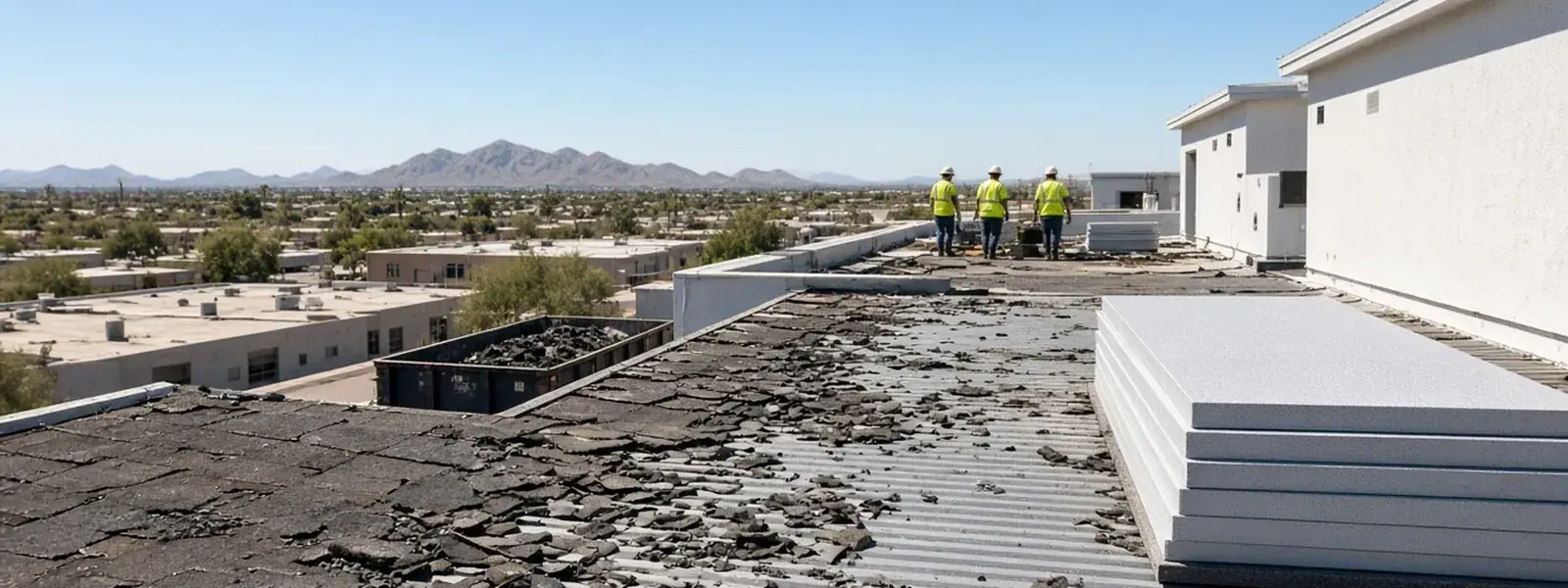
Replacement is the job you call when cores are wet, when plan review will not allow another recover, or when the field has been peel-stopped so many times there is nothing left to weld to. In Scottsdale that decision sits on top of monsoon drainage, 175F surface temps, and an IBC roof-count rule that catches a lot of East Valley buildings on their second recover. Property managers want a number and a schedule. What they need first is a code path, a tapered layout, and an attachment pattern the deck can actually hold. Scottsdale Commercial Roofers runs commercial roof replacement as a tear-off or a legal recover with cover board, documented LTTR, and flashings built for desert thermal cycling, not a membrane drop on a wet sandwich.
What this job includes
- Cores and moisture mapping to set tear-off versus legal recover before we bid the dumpsters
- IBC roof-count check and City of Scottsdale (or East Valley) permit path
- Tear-off to deck where required, with night seals if the roof must stay open overnight
- Tapered polyiso designed to drains and scuppers, with LTTR called on the submittal
- Cover board over the iso at the field, perimeters, and high-traffic zones
- FM 1-90-style perimeter and corner enhancement when the building or carrier requires it
- New clamp-ring drains, overflow scuppers, and cricket layout at wide curbs
- Membrane system matched to the building: TPO, mod-bit, metal, or SPF recover where it is honest
- Parapet wrap or termination-bar and counterflashing rebuild, not a reuse of failed metal
- Photo log of deck, fastener pullout, insulation, and finished welds or laps for the file
When this is the right call
Cores came up wet across multiple bays
Wet polyiso does not dry out under a new sheet in this heat. It steams, blisters, and feeds the next leak map. Once the moisture is field-wide, replacement with tear-off is the clean path.
You already have two roofs on the deck
A third roof is a plan-review problem in most IBC jurisdictions. If the cores show two complete systems, we tear off. A “thin recover” that ignores roof count gets red-tagged.
The membrane will not take another weld or patch
Aged TPO that has lost plasticizer, bald mod-bit over rotten felts, or foam that has cooked down to orange crunch cannot be repaired into a remaining-life story. You are maintaining a failure.
A buyer, lender, or FM account wants a remaining-life reset
Capital replacement is sometimes a transaction requirement. We still design it as a roof, with taper and attachment, not as a cosmetic overlay to clear a punch list.
Drainage was never right and ponding cooked the last system
Replacing membrane without adding taper is how you buy the same birdbath. If the structure is flat, replacement is the moment to put slope in the insulation.
How the work actually runs
Move 1
Investigate, then write the system
Cores, infrared, drain survey, fastener pullout, and a roof-count. We pick tear-off or recover, then pick membrane and attachment from deck type and wind. The spec is written before the first dumpster, not on the fly from the parapet.
Move 2
Permit, staging, and occupied-building plan
City card, fall protection, interior protection at tenant spaces, and a night-seal plan if tear-off cannot finish in one shift. Warehouse and office replacements fail in the lot if staging is sloppy. We plan crane picks and RTU shut-downs with you.
Move 3
Tear off to a deck you can trust
Wet iso, rotten recover, and failed fasteners come out. Deck repairs happen while it is open: rusted flutes, bad lightweight concrete, loose boards. We do not hide a bad deck under pretty cover board.
Move 4
Build insulation, cover board, and the membrane
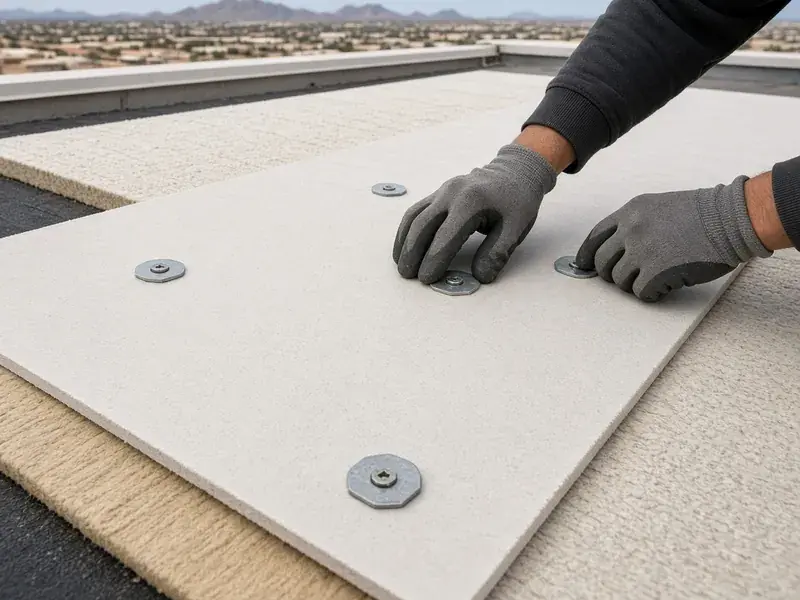
Tapered polyiso goes to the drainage plan. Cover board follows. Membrane is attached to the tested pattern, with denser fasteners at perimeters and corners. Flashings, drains, and walk pads are new, not leftovers from the roof you just threw away.
Move 5
Quality control and close-out
Seams are probed or bleed-out is read. Drains are water-tested. You get as-builts, photos, and the insulation LTTR stack. Punch items get closed before we call it a replacement.
Why this crew for commercial roof replacement
Code path before the sales number
Roof count, permit, and wet cores decide tear-off. We will not win a bid with a recover that cannot pass plan review.
Taper is part of replacement
A new white sheet on the old birdbath is a new white birdbath. Drainage design is in the price because monsoon water is why the last roof died.
Cover board and FM-style edges
Cover board takes the traffic and the fastener head. Perimeter enhancement takes the wind. Those two lines are where cheap replacements come apart in year two.
Deck honesty while it is open
Replacement is your chance to see the structure. We repair what we open. Hiding rusted flutes is how the next roof inherits the last failure.
A professional crew on an occupied building
Night seals, interior protection, licensed and insured commercial replacement. Fast response if weather moves in mid-tear-off. The building stays in business.
IBC roof covering provisions are the silent partner on East Valley replacements. You generally get two roofs. A recover over one dry system can be legal and smart. A recover over two systems, or over wet insulation, is how jobs stall at inspection. We put the roof count in the first site report so ownership is not surprised when the dumpsters show up. City of Scottsdale plan review is not the place to discover you already used your last recover.
Polyiso is specified by LTTR, long-term thermal resistance, not by a hopeful R-number on a brochure. In this climate the iso also has to live under a 175F membrane. Cover board is the buffer. High-density iso or gypsum keeps fasteners from punching and gives TPO a weldable plane. Skipping cover board to “sharpen” a replacement bid is how you get a soft field and a callback when the first HVAC tech walks a path to the unit. We keep cover board in the spec even when a competitor cuts it to win the number.
Wind design on a Scottsdale replacement is about monsoon outflows and building height, not about coastal hurricane theater. FM 1-90 is a common language for fastening patterns even when the building is not a formal FM account. Perimeters and corners get more plates. That is where peels start. We write the pattern from pullout values. A screw that spins in lightweight concrete does not become a roof because the takeoff said 12 inches on center. If pullout is weak, we change the fastener or the method before we load the field.
Tear-off in monsoon season is a staging problem as much as a roofing problem. We size daily openings to what we can dry in. Night seals are real: membrane, mastic, and a termination that can take a 2 a.m. cell. An open deck over leased space is not a place for optimism. If the forecast is ugly, we shrink the opening. Replacement still finishes. It finishes in controlled bites. A smaller square that is sealed beats a heroic opening that takes weather overnight.
System choice at replacement is the one time you can change the building’s heat and maintenance story. White TPO for a big, relatively clean field. Mod-bit for a small, abused wing. Standing seam where slope exists and the look matters. SPF only as a recover on a dry, legal substrate. We do not have a house membrane. We have a deck, a drainage plan, and a tenant stack that has to live under the work. That conversation happens with cores on the table, not with a single product brochure.
Where this work goes
We run commercial roof replacement across Scottsdale and the East Valley. For the full city list, open Where We Work. Priority walks after Scottsdale are Phoenix, Mesa, Tempe.
If cores, roof count, or a dead field have you looking at commercial roof replacement in Scottsdale, call Scottsdale Commercial Roofers. We will set the code path, the taper, and the attachment before anyone orders a roll. Then we will replace the roof like the building is staying open, because it is.